Portrait
Jian Luo
Ph.D. Student
Stony Brook University
About Me

I am a first-year Ph.D. student in the Department of Applied Mathematics and Statistics at Stony Brook University, advised by Prof. Chao Chen. My current research interests focus on the post-training and applications of diffusion large language models. If you share similar interests and would like to connect, feel free to reach out via email.

Before joining Stony Brook University, I received my M.E. degree in Electronic Engineering from University of Science and Technology of China in 2025. During my master's program, I worked on several nice research projects related to deep learning and its applications.

Selected Publications (view all )
Can Data-Driven Dynamics Reveal Hidden Physics? There Is A Need for Interpretable Neural Operators

Wenhan Gao*, Jian Luo*, Fang Wan, Ruichen Xu, Xiang Liu, Haipeng Xing, Yi Liu (* equal contribution)

Under review. 2025

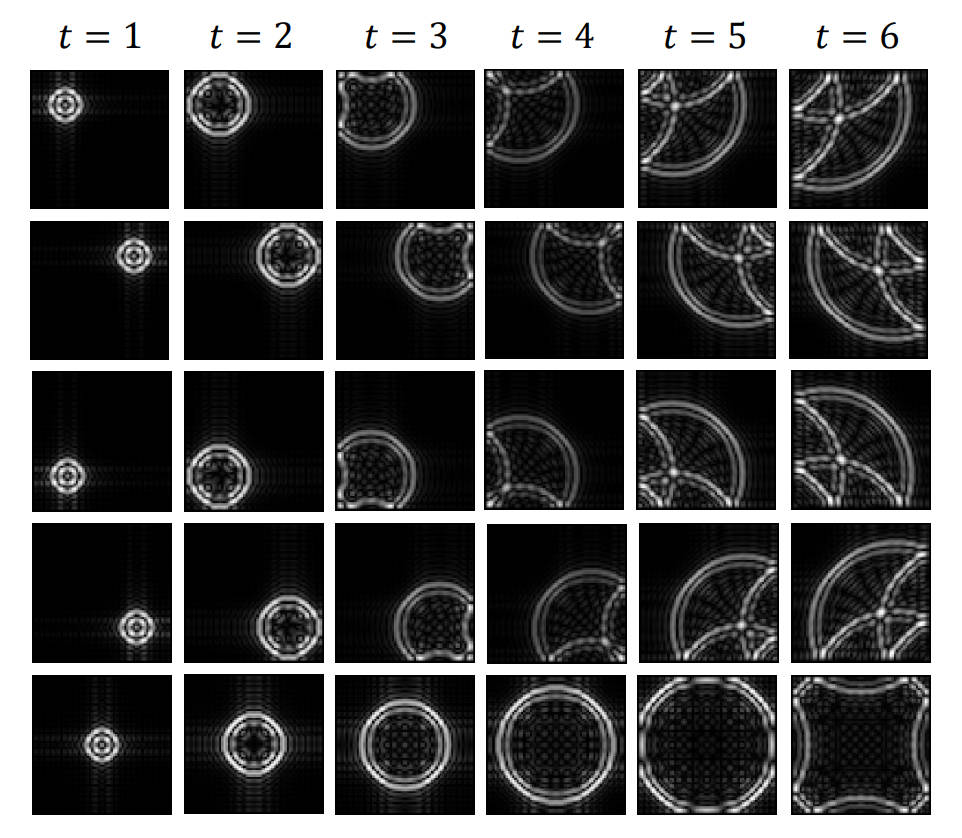
We provide a way to explain the prediction-making process of neural operators and show that neural operator can learn hidden physical patterns from data. However, this explanation method is limited to specific situations, highlighting the urgent need for generalizable explanation methods. Next, we show that a simple dual-space multi-scale model can achieve SOTA performance and we believe that dual-space multi-spatio-scale models hold significant potential to learn complex physics and require further investigation. Lastly, we discuss the critical need for principled frameworks to incorporate known physics into neural operators, enabling better generalization and uncovering more hidden physical phenomena.

Can Data-Driven Dynamics Reveal Hidden Physics? There Is A Need for Interpretable Neural Operators

Wenhan Gao*, Jian Luo*, Fang Wan, Ruichen Xu, Xiang Liu, Haipeng Xing, Yi Liu (* equal contribution)

Under review. 2025

We provide a way to explain the prediction-making process of neural operators and show that neural operator can learn hidden physical patterns from data. However, this explanation method is limited to specific situations, highlighting the urgent need for generalizable explanation methods. Next, we show that a simple dual-space multi-scale model can achieve SOTA performance and we believe that dual-space multi-spatio-scale models hold significant potential to learn complex physics and require further investigation. Lastly, we discuss the critical need for principled frameworks to incorporate known physics into neural operators, enabling better generalization and uncovering more hidden physical phenomena.

Neural Krylov Iteration for Accelerating Linear System Solving

Jian Luo, Jie Wang, Hong Wang, Huangshuo Dong, Zijie Geng, Hanzhu Chen, Yufei Kuang

Advances in Neural Information Processing Systems (NeurIPS) 2024 Spotlight

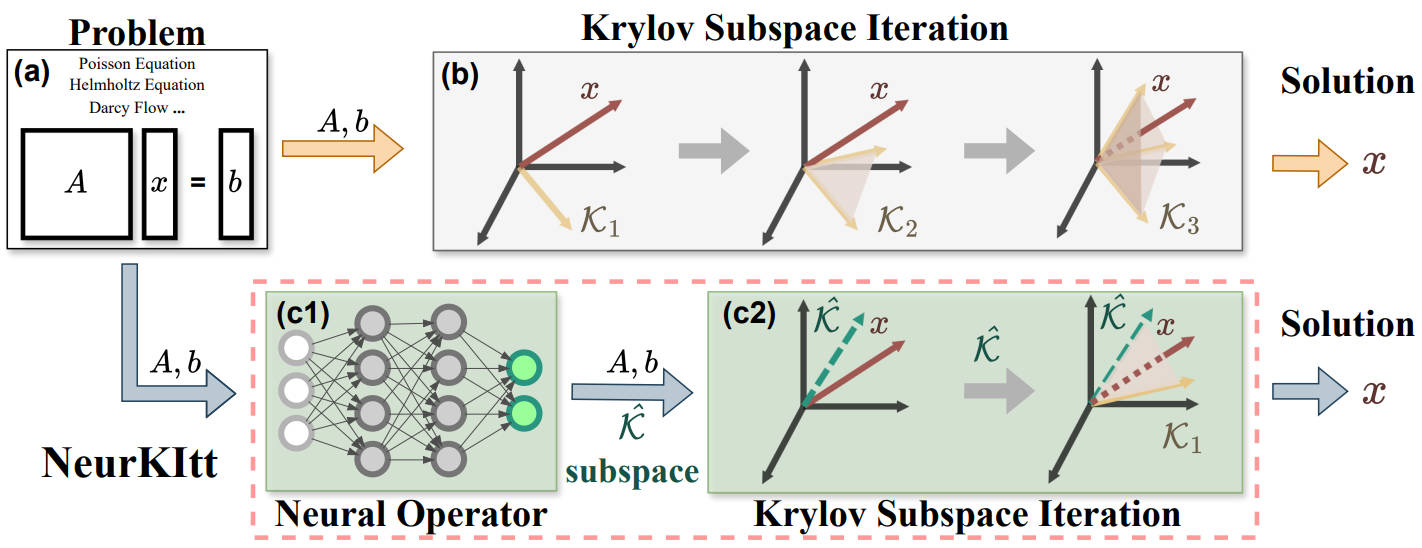
We propose a novel method, namely Neural Krylov Iteration (NeurKItt), for accelerating linear system solving. To enhance the subspace prediction accuracy, we utilize QR decomposition for the neural operator outputs and introduce a novel projection loss function for training. NeurKItt accelerates the solving of linear systems across various settings and datasets, achieving up to a 5.5× speedup in computation time and a 16.1× speedup in the number of iterations.

Neural Krylov Iteration for Accelerating Linear System Solving

Jian Luo, Jie Wang, Hong Wang, Huangshuo Dong, Zijie Geng, Hanzhu Chen, Yufei Kuang

Advances in Neural Information Processing Systems (NeurIPS) 2024 Spotlight

We propose a novel method, namely Neural Krylov Iteration (NeurKItt), for accelerating linear system solving. To enhance the subspace prediction accuracy, we utilize QR decomposition for the neural operator outputs and introduce a novel projection loss function for training. NeurKItt accelerates the solving of linear systems across various settings and datasets, achieving up to a 5.5× speedup in computation time and a 16.1× speedup in the number of iterations.

All publications